
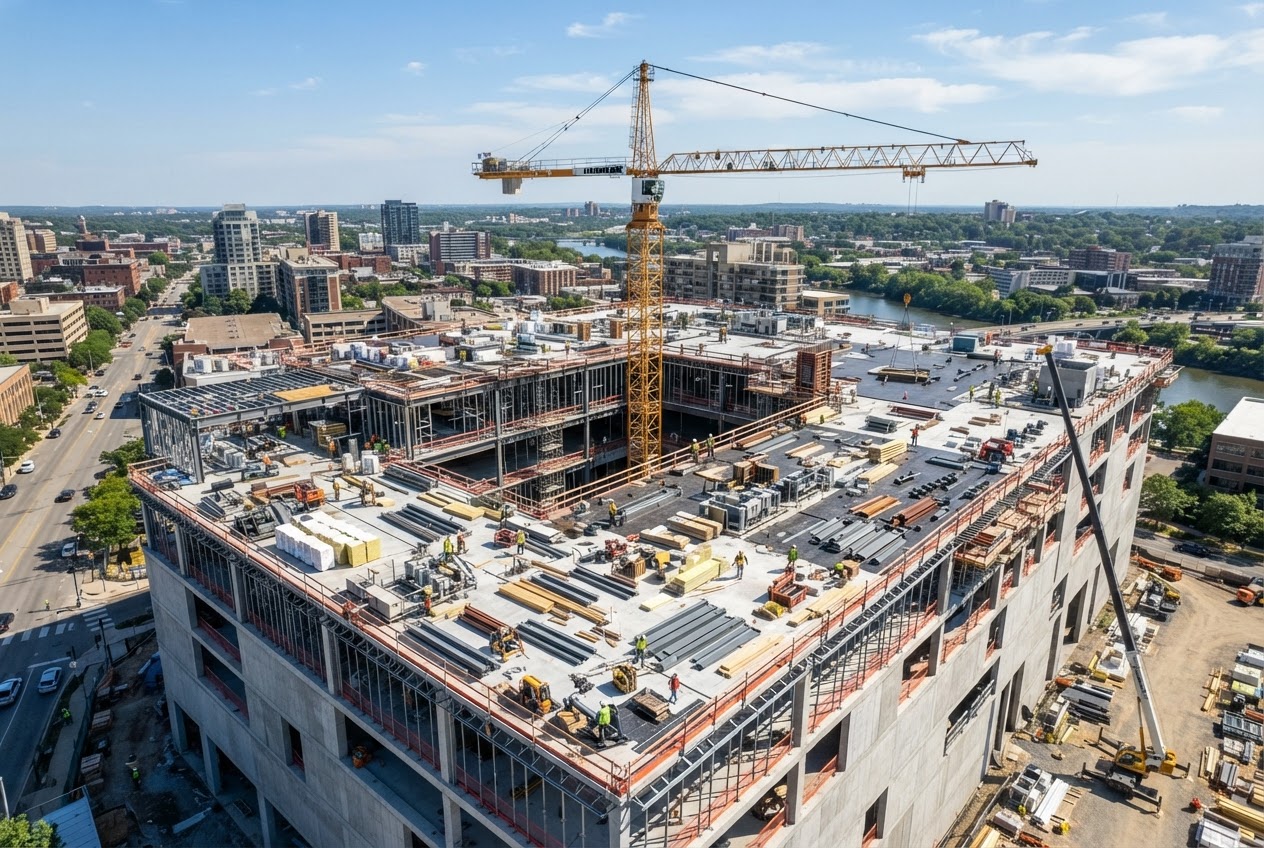
Some of the most compelling work in the exterior contracting industry can’t be fully appreciated from ground level.
A 50-square roof replacement. A large commercial flat roof installation. A multi-building siding project. Standing on the street, you can see the front elevation — but you can’t grasp the scale, the complexity, or the full scope of what the crew accomplished. Drone footage captures what ground photos can’t.
Aerial photography for construction companies has become one of the most effective sales and marketing tools in the industry — not because it looks impressive (though it does), but because it answers the question homeowners and project owners are always asking: how good is this contractor, really?
What Aerial Photography Provides That Ground-Level Photos Can’t
Every contractor has a gallery of jobsite photos. Not every contractor has aerial footage. That difference matters when you’re competing for a significant project.
Scale and Scope
Aerial photography shows the entire footprint of a project at once — the full roofline, all elevations, the relationship between the structure and the surrounding property. For large residential or commercial projects, this view communicates the scale of the work and the capacity of the crew in a way that ground photos simply can’t.
Access to Difficult Areas
High-pitch roofs, complex architectural details, and inaccessible commercial rooftops are impossible to document properly from the ground. A drone captures footage of these areas without anyone climbing additional ladders or creating safety risks. The result is documentation of craftsmanship that would otherwise be invisible.
Before-and-After Transformations
Aerial before-and-after comparisons are some of the most compelling content a contracting business can produce. The transformation of a worn commercial roof or a weathered residential exterior is far more striking from above than from street level — and that impact translates directly into sales conversations and proposal close rates.
How Construction Companies Use Aerial Photography
Aerial footage isn’t just for portfolios. Construction companies and exterior contractors are using drone content across every stage of their marketing and sales process.
Proposals and Bid Presentations
Including aerial footage from comparable past projects in a bid presentation communicates capability and professionalism immediately. A commercial project owner evaluating multiple bids notices the company that can show — not just tell — the scope of similar work they’ve completed.
Website Portfolio
Aerial project photos in your website portfolio establish a quality ceiling that differentiates you from competitors who only show ground-level shots. They signal that your business takes documentation seriously and invests in presenting its work professionally.
Google Business Profile
Google Business Profile prioritizes fresh, high-quality photos. Aerial project images stand out in a local search results gallery and typically generate higher engagement than standard ground-level shots. They also communicate to homeowners scrolling through search results that this is a serious, established operation.
Social Media and Paid Advertising
Drone footage performs exceptionally well as video content on Facebook, Instagram, and YouTube. A short aerial walkthrough of a completed roof or siding project generates significantly more reach and engagement than a static photo, and it works well as ad creative for remarketing campaigns.
Internal Documentation
Beyond marketing, aerial photography is useful for pre-inspection documentation, progress tracking on large projects, warranty documentation, and insurance claims support. A drone survey of a roof before and after installation creates a defensible record of condition and workmanship.
What Aerial Photography Coverage Looks Like for a Contracting Job
A professional aerial photography session for an exterior contracting project typically captures the following.
Establishing Shots
Wide overhead and angle shots that show the full property and surrounding context. These are the images that communicate scale and scope — the “hero” shots used in proposals, portfolios, and advertising.
Detail Passes
Lower-altitude passes that capture specific elements of the work: ridge installation, flashing details, gutter alignment, siding courses, or specific architectural features. These shots demonstrate craftsmanship and are effective in sales conversations with technically-minded clients.
Before-and-After Pairs
When aerial footage is captured both before work begins and after completion, the resulting before-and-after pair is one of the most versatile marketing assets a contractor can have. It can be used in print, digital, social, and paid advertising for months or years.
Video Walkthrough
A slow, smooth drone walkthrough of the completed project — two to three minutes at most — is a polished, shareable asset that works as website content, sales presentation material, and social media video.
Using a Drone Operator vs. In-House Drone Capability
Contractors have two options for accessing aerial photography: bringing it in-house or working with a contracted drone operator.
In-House Drone Operation
For contractors who complete a high volume of projects, in-house drone capability can be cost-effective. The investment includes the drone equipment (typically $500–$2,000 for a capable consumer or prosumer model), FAA Part 107 certification for commercial drone operation, and basic training in jobsite photography techniques.
The advantage is availability — you can document every project without scheduling coordination. The disadvantage is that in-house operators rarely match the image quality and editing polish of dedicated professional photographers.
Contracted Drone Operators
For larger, more significant projects, working with a professional drone operator delivers noticeably better results. A skilled drone photographer understands lighting, flight planning, editing, and how to capture footage that tells a story — not just documents a roof.
The cost for a professional drone photography session for a single project typically runs $200–$600, depending on location and session length. For flagship projects, this investment pays for itself many times over in proposal conversions and marketing value.
Building an Aerial Photography System Into Your Operations
The goal isn’t to capture drone footage occasionally on impressive projects — it’s to build a systematic approach to aerial documentation that produces a steady stream of high-quality content.
For contractors doing 50+ jobs per year, even capturing drone footage on 20–30% of projects provides enough material to keep all marketing channels fresh with compelling, differentiated content.
Get Aerial Photography Working for Your Business
Apex Exterior Marketing integrates aerial photography and drone content into complete marketing systems for exterior contractors — from coordinating shoots on major projects to editing, distributing, and getting footage to work across your website, social media, and ad campaigns.
Reach out to learn how aerial content could elevate your portfolio and help you win larger, higher-margin projects.